Vanessa Karin: “Desire is a force that runs through us and moves us to do things.”
- Rodrigo Ahumada
- Dec 5, 2025
- 13 min read
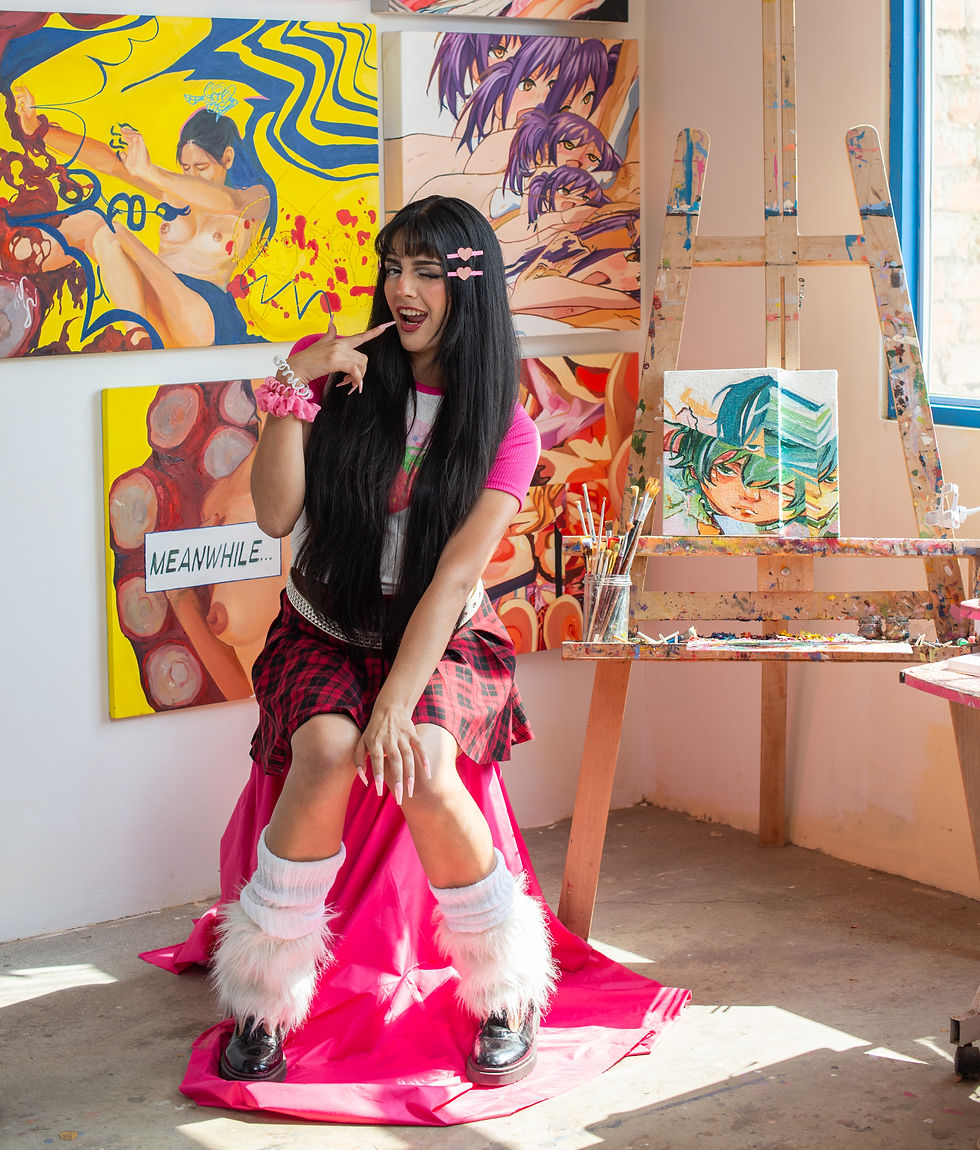
Interview conducted by Rodrigo Ahumada
In Vanessa Karin's work, desire is neither compliant nor decorative: it is a territory that causes discomfort, that takes risks, that is sustained between vulnerability and protest. Her painting dialogues with the tradition of anime and manga, but not through replication; rather, it critiques those languages, traversing them with her personal history, her Catholic upbringing, the scars of harassment, and the finding of the gaze as both weapon and refuge.
In this conversation, Vanessa unfolds the tensions between body and dogma, pleasure and politics, intimacy and memory, in a country where discussing sex can still be read as an act of rebellion.
Your work stems from an intimate exploration of desire and the body, often from a place of discomfort. What type of desire are you interested in representing, and why do you choose to provoke discomfort with it?
I hadn't realized my work caused discomfort, but I have been told several times that at first glance, it is somewhat jarring.
I am very interested in sexual desire, I’m not sure why; I think that's why I work with it so much. I don't consider my intimate life to be particularly different; I’m quite common in that sense, but I am very curious. I question deeply why people are attracted to one another, why one rejects some people, or why I am drawn to certain types and not others.
I have been researching this through philosophy. I am reading Anti-Oedipus by Guattari and Deleuze, and it is helping me a lot. Initially, I worked from intuition, but now I feel that my painting is enriched by an academic approach in addition to the plastic one.
You transform the digital nude, which is ephemeral and private, into an artistic object charged with permanence. How does this re-signification dialogue with your personal history and the social rules you inherited regarding the body?
In that work where I took my own nudes and re-drew them, what I did was choose what stood out the most from the photo, what seemed most important to me. That gesture already implies a personal filter, but also an academic one, because my background in painting is inevitably present.
I also wanted to go somewhat against the idea that "I shouldn't do it": I shouldn't take a nude photo because it could be dangerous. If my photos were leaked, my life could be ruined, I could be humiliated, or even lose job opportunities. That’s why those "rules" exist. Even legally, in Mexico there is the Olimpia Law against digital harassment, and in Peru we are just starting to get something similar. I wouldn't say I did it as an act of liberation, but rather out of curiosity. I feel that I am already free and that it is desire that guides me to experiment.
What you say about inherited norms strongly resonates with me. I was raised in Catholicism. Today I question the Church, but I am still associated with it, though not dogmatically. That upbringing forces me to consider why so much has been said about the female body.
Freud spoke of the "Madonna complex," that division where women are split: on one side the virgins and mothers who nourish and give life; on the other, the prostitutes who serve sexually. That division still runs through the way we are looked at. When I take the nude and transform it into art, I am saying that we are neither just virgins nor whores: we are many things at once, complexities and experiences that do not fit those labels.
That complex also affects relationships. There are men incapable of loving women in their totality because they cannot see the maternal and the sexual in the same person. That's why they sometimes seek out prostitutes, not because they don't have sex with their partners, but because with them, they feel they can experience what they would never do with their wives, whom they do not consider capable of desire or of being seen as sexual beings. This division continues to mark intimacy.
Do you seek to communicate this in your paintings, or how does it relate to your works?
This primarily relates to my first solo exhibition, which was titled Flirty cry baby. That exhibition revolved around the woman split in two, but I approached it through self-portraiture and what I call my late adolescence.
I say late adolescence because today adolescence lasts longer, almost until your twenties. In my case, I feel I was an adolescent for longer than I "should have been." Furthermore, I grew up in a very protected, Catholic environment—a kind of bubble where everything was fine, which prolonged both my childhood and my adolescence.
In that first solo show, I worked on the tensions of the divided woman, caught between virgins and prostitutes, connected to my religious upbringing and also to my consumption of anime since childhood. We always watched anime at home because my godmother is nikkei (Japanese-Peruvian descent) and my uncle bought DVDs at Polvos Azules. I grew up exposed to both shoujo—for girls, with sweet and romantic heroines—and hentai, which is pornographic anime intended for men. Comparing them, I noticed the enormous difference in the construction of the heroines, even when they were characters my own age.
For example, in one painting, I portray myself as Sawako, the protagonist of Kimi ni Todoke, the most tender and virginal heroine I had seen. And I imagined what would happen if she became friends with Hayase, from the hentai Sexfriend. That mix attracted me: bringing together the virgin and the prostitute as if they were becoming friends.
In Sexfriend, what caught my attention was that Hayase exercised control over her desire: she chooses to have sex without emotional ties, even when the protagonist wants to make her his girlfriend. That autonomy contrasts greatly with Western pornography, where control is rarely in the hands of the woman. So, I wondered: what would happen if these two very different girls met? I transferred that tension to my paintings, where these worlds coexisted.
Your artistic practice assumes pleasure as a disruptive force, capable of causing discomfort and questioning. Do you believe it is still possible to view pleasure as a political stance, without falling into moralism or the romanticization of sexual liberation?
Yes, I totally agree. I don't know if I can fully explain it with words, but I feel that I do so with painting. I work from my own positions: I believe in God, but I am neither moralistic nor dogmatic. I question the Church, I am critical of what happens within it, and precisely for that reason, I believe that sex as a political stance is necessary. In Lima, which is so religious, sex is still marked by the idea of sin. You just have to look at the advertising during Holy Week that says: "sin and have sex this week." It may sound funny, but it shows how words still carry that moral weight.
Regarding the idea of sexual liberation, I think that as long as one does not harm others, it is fine. Ultimately, each person is on their own path, exploring what they want and what they seek. Sexuality is personal, I would even say spiritual. For me, spirituality is unique, an intimate relationship with God, and I feel that sex has that same quality. No experience is repeated, every couple is different, and in that development, there is a profound discovery. Sometimes I think it is so personal that it is not even fully shared. Perhaps that's why there is so much pornography on the internet: because people feel they can experience practices there that they don't dare or don't have the opportunity to explore in daily life.
I am still elaborating on these ideas about sex and the spiritual; I want them to be the core of my third solo show. But I can say that, when I started painting, I experienced it as an ecstasy, a strange and intense experience. Now I feel I am uniting those two dimensions: sex as a political experience and sex as a spiritual experience.
I currently do not consume any substance that alters my nervous system; I've been clean for almost two years. So, I keep thinking about what you mention about sex as spiritual, because lately my ecstasy no longer comes from pushing the body to the limit with substances, but through writing, sex, and seeking passionate bonds.
The other day I heard that good sex makes you forget you are going to die. The French call orgasm la petite mort (the little death), like you die for a moment. But I believe it's the opposite: you don't die; rather, you live and forget that there is death. Perhaps it goes there, because spirituality is ultimately that experience of feeling one with everything.
Why do we desire what we desire? Do you believe desire is something that is born within us or something we have been taught to yearn for? How does your work engage with that question and push, dismantle, and reassemble it from the body?
I don't know. It's what I always think about or try to find. Maybe I'll never solve it. But it's strange, because while it seems desire is taught, it's not always the case. I think, for example, of a traditional family with five children raised the same way, with the same education, the same school, yet they all end up being different. So maybe desire isn't taught; perhaps it is already with you. That's precisely why I talk about desire as that force that drives you to create.
In what I'm reading from Deleuze and Guattari, they talk about desire as a productive force that pushes you to create because you yearn for it and move towards it. Sometimes I imagine desire as something that traverses us, that is floating and moves us to do things. Although, of course, there are also desires that we are taught to have.
I remember reading mangas as a kid, and at the kiosks in Magdalena they sold Dragon Ball ones, but erotic ones. I showed them to a cousin and he said: "Do you masturbate watching Candy?" For him, it wasn't normal or attractive, and I questioned why it was for me. So, even if that desire is born with me, at what point does it develop?
What you tell me about Dragon Ball is a doujinshi. When you mention doujinshis, I immediately think of hentai, which is the animated version, but often born from manga. Doujinshis are precisely those mangas where existing characters are taken and transformed into pornographic material. I have consumed many myself and, in fact, sometimes find them more satisfying than animation, because in reading, you participate more: you don't just receive the image; you also contribute with your imagination and your own desires. That's where the fantasy is completed, in that mix between what you read and what you invent in your head.
In my work, I take a lot from those references, especially from hentai covers or Japanese magazines that review this type of content. Sometimes I base myself on the painted version, other times on the animated one, but I always modify the images. For example, if in the original the girl's face expresses suffering, I change it: I remove the arched eyebrows and show her enjoying it, because for me, it is fundamental that the sexual act be consensual. That is my personal, and also political, filter: I want what I represent to be aligned with my beliefs—that the characters are enjoying themselves, not being subjected.
As in La realidad de la fantasía (The Reality of Fantasy, 2022, Oil and embroidery on canvas/fabric), where there is intense bodily tension. The only painting where you worked with a more violent act was a self-portrait where you appear pulled by an octopus. Even there, you portray yourself trying to protect yourself. That painting was embroidered with the image of Yuno Gasai, an anime protagonist who is a yandere: sweet in appearance, but capable of going crazy and killing. I liked that idea of the woman who manages to defend herself, even killing her harassers.
There is something monstrous in many of your pieces, a corporality that does not seek to please but to disconcert. What place does the grotesque or the non-normative occupy in your work? Is it a form of protest?
The grotesque part for me is the non-consensual, and that in my works comes from personal experiences. It's not a theme I seek to portray on purpose, but it appears because I have experienced it. At university, I had a stalker who sexually harassed me for a year. First, it was text messages, and then he started waiting for me outside the classroom. There was a disciplinary process, but the statutes did not contemplate such a case, so there was no real way to sanction him. Luckily, my professors helped me, they changed my classroom, they tried to protect me. Even so, it was terrifying, and the hardest thing was realizing that, even when you ask for help, often they can't provide it.
I think that's why my work in that vein is also an act of protest. I did not get justice at that moment; there was no punishment for that person. Later, I participated in an assembly on sexual harassment, I spoke about what had happened, and that gave me some vindication, but it was already too late: the damage was done.
And it hasn't been the only experience. Since childhood, I have experienced street harassment. I remember when I was 14, an older man offered me work as a waitress in some cafes in the Arenales Gallery. I went with a friend, excited, and he told us that they wouldn't pay us, they would only cover bus fares, and we had to wear tiny clothes. It wasn't until I was an adult that I understood the danger of that situation, but at that age, you don't realize it.
That's why the grotesque in my work is not a mere aesthetic resource; it is a way of giving body to those experiences of harassment, discomfort, and violence that leave their mark. It is also a protest against what was not addressed, against the lack of justice.
There is something very intimate about how you use the gaze. One that perhaps previously exposed you, watched you, or made you feel uncomfortable. Now it seems to be yours, trained, converted into language. What has that transition been like—from being looked at to making that gaze an extension of yourself?
That's interesting what you tell me, because right at the beginning of everything, when I was still studying, I did a work of self-portraits where the spectator didn't see the painting head-on, but the back of the canvas. To see the painting, you had to peer, put your gaze between the mirror and yourself. I did it precisely because I felt constantly invaded.
That transition has been long. Over time, I have questioned where I feel comfortable exposing certain parts of my body and where I don't. I always say that I doubt I will ever upload nude photos. I feel that I do expose my body, but with the filter of painting, and in this way, it remains mine: no one else sees it.
I remember that during my first solo show, I was running late, the works weren't finished, and a friend told me, "I'll help you paint." I replied: "Are you crazy! You're not going to see me naked painting." And those were just photos. But it was very clear to me: that territory is mine. That's why I've never asked for assistants, even though it's common in art, because showing them that material would be too much.
In the end, learning to look has been very personal. And yes, there is a part of me that enjoys causing discomfort when I show myself nude in my works. I am interested in seeing the reactions; I even find it a bit amusing. I remember the first time my father was surprised, but at the same time he was happy. For him, it was an achievement that I had a solo show. His fears initially were that people would speak badly of me, but then he realized that no, that doesn't happen. That it is art.
You utilize resources from manga and anime, visual media with their own baggage of sexualization and fetish. What interests you about those languages, and how do you re-signify them in your plastic work without replicating their patriarchal logics?
As I told you, I usually make slight changes to the images I choose; for example, I remove things that I feel do not align with what I think or believe. Initially, when I used characters, I did so also because of what they represented within their worlds. It was like taking them out of there and putting them into mine. Each character already carried a load of meaning. For example, in the case of Sawako, one would think she is not sexual because of her "pure" way of loving, but she is a sexual character because she is seeking to fall in love. There is sexuality; it's just not visible at first glance.
In the paintings I am currently doing, I have abandoned my human figure, and human figures in general. I am more interested in the abstraction of the image, although without reaching complete abstraction: I remain in figuration. I got tired of myself. I think adolescence is very self-referential; you think the world revolves around you, and it's not like that: we are actually inserted into a chain of things. What happened to me—the fact of having gone to Arenales Gallery and suffering harassment—is not unique; it happens to many women. In fact, it is said that one in three women will experience some type of sexual harassment in their lifetime. So, it is no longer necessary to paint myself or paint people to talk about people. I don't have to paint them anymore. When I used anime figures before, I treated them as avatars: you can see yourself reflected in the one you want without needing to paint yourself.
My interest in anime comes from childhood. I am very close to my father's family, and my studio is in my grandfather's house. When I was a child, we all lived there at some point, and my godmother is nikkei. My cousins watched anime, and one day my uncle decided to stop paying for cable and started buying DVDs at Polvos Azules. That's how I started watching anime at home. Since my cousins were older, they protected me from what I watched: they didn't show me the violent animes. I grew up watching a lot of shoujo, in addition to what was on TV. I especially remember Fruits Basket, which I watched with my cousin. There were scenes that scared me, and my cousin would stay with me during those moments. For me, it is something very familiar, even though anime is Japanese. If my uncle hadn't married my nikkei godmother, perhaps I never would have seen it. It was a coincidence that ended up marking me.
In a country like Peru, where sexuality is still a topic regulated by dogma, how do you perceive the reception of your work? Do you feel there is space for uncomfortable art, or is there still a need to hide desire?
I've been lucky, because so far, I have never been completely censored. In this last exhibition at the Alliance Française, for example, something curious did happen: two of my pieces are removed on Saturday mornings because there are activities with children that day. They explained it to me exactly like that: "The paintings will only be stored away during those hours."
I don't think it's normal, but, all things considered, I was grateful. I thought: "Well, thank you for not censoring the entire show," because somewhere else, they might have closed it completely. They found a middle ground. I understand the care towards children, but I find it exaggerated, because there are no exposed genitals in those works.
Listening to Vanessa Karin is to understand that her work does not seek closed answers, but persistent questions: What do we desire? How is the monstrous constructed? What does it mean to be looked at and to return that gaze through painting? Between the grotesque and the intimate, the familiar and the perturbing, her work moves as a productive force—in the Deleuze and Guattari sense—that not only represents but produces desire, discomfort, and thought.
In times when the body remains a field of dispute, her paintings open up an uncomfortable but necessary space to inhabit our contradictions.
Image Credit: Fiorella Photography | MUA & Hairstyle: Ro Bellmunt | Styling: Valeria de Carlo | Creative Direction: Vanessa Karin
Comments